What's the Mortgage Rate Right Now, and Will It Go Down Before I Buy?
August 3, 2026
Mortgage
August 3, 2026
Mortgage
Key Takeaways
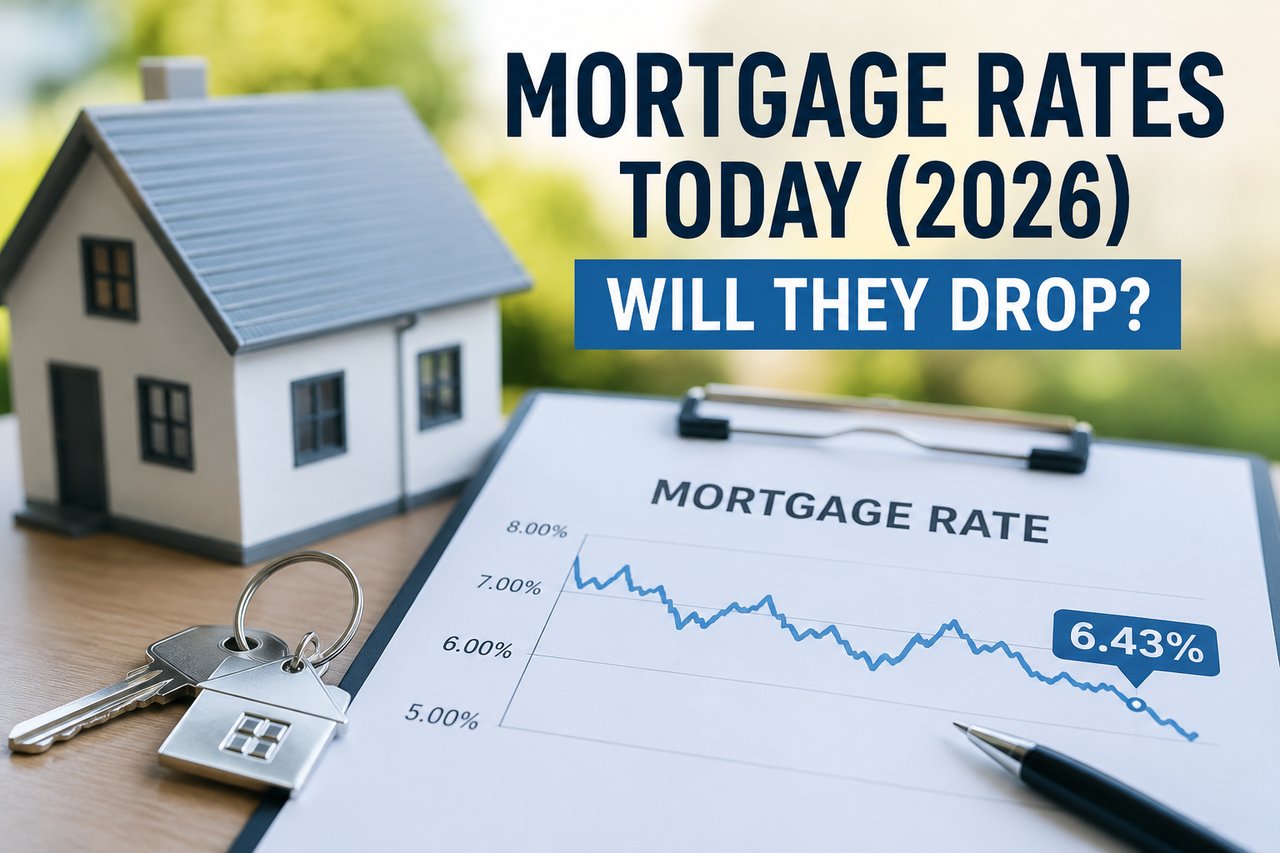
As of late July 2026, 30-year fixed mortgage rates sit in the mid-6% range — Freddie Mac’s weekly
survey had them at 6.43% (week of July 2), with daily trackers showing 6.43%-6.73% Freddie Mac,
Mortgage News Daily, Mortgage Research Network. A meaningful drop isn’t guaranteed before you buy,
and the Fed just held rates steady for a fifth straight meeting, so plan around today’s rate rather than
betting your purchase on a rate cut. Federal Reserve
Let’s Just Answer the Question: What’s the Rate Today?
You want a number, so here’s the number. As of late July 2026, 30-year fixed mortgage rates are sitting
in the mid-6% range. Freddie Mac’s official weekly survey put the average at 6.43% for the week of July
2, 2026 Freddie Mac. Daily rate trackers, which move faster than Freddie’s weekly number, show a
slightly wider range — Mortgage News Daily had rates around 6.43% to 6.60% in late July, while
Mortgage Research Network showed 6.73% specifically on July 30, 2026 Mortgage News Daily,
Mortgage Research Network.
Why the spread between sources? Weekly surveys smooth out day-to-day noise, while daily trackers
reflect real-time lender pricing. Both are “correct” — they’re just measuring on different clocks. My
advice: use the weekly Freddie Mac number for big-picture trend-watching, and check a daily tracker the
week you’re actually locking a rate.
What That Actually Costs You Every Month
Rate quotes are abstract until you see them on a real loan. Here’s the payment math on a $300,000 loan
(principal and interest only, no taxes or insurance) Freddie Mac MyHome:
Notice that each half-point of rate costs you roughly $100 a month on a $300K loan. That’s the
framework I want you to walk around with: don’t ask “will rates drop,” ask “what specific payment am I
comfortable locking in, and at what rate does that happen.”
Why Rates Are Stuck Here — Not Higher, Not Lower
To understand where rates might go, you need to understand why they’re exactly where they are.
The Fed Just Held Steady — Again
On July 29, 2026, the Federal Reserve held the federal funds rate at 3.50%-3.75% for the fifth
consecutive meeting Federal Reserve. What’s notable isn’t just the hold — it’s that the vote was a
surprisingly split 9-3, with three officials (Beth Hammack, Neel Kashkari, and Lorie Logan) actually
wanting to raise rates over inflation concerns Federal Reserve, CNBC. The Fed’s own statement cited
elevated inflation and Middle East conflict uncertainty as reasons for caution Federal Reserve. Important
nuance for buyers: the Fed doesn’t directly set mortgage rates, but this kind of hawkish hesitation keeps
long-term rates like the 30-year mortgage anchored rather than sliding down.
Inflation Is Improving, Which Is the Real Rate Story
Here’s the more hopeful data point: June 2026 CPI came in at 3.5% year-over-year, down sharply from
4.2% in May — the biggest one-month drop since April 2020, largely thanks to falling gas prices BLS,
Reuters. Core CPI sits at 2.6% BLS. This is exactly the kind of trend that eventually earns the Fed enough
confidence to cut — but “eventually” is doing a lot of work in that sentence, and the July 29 meeting
showed the Fed isn’t there yet.
A Wobbly Jobs Market Adds Pressure — In Both Directions
June’s jobs report added just 57,000 jobs, about half of what was expected, and unemployment ticked
down to 4.2% mostly because people left the labor force CNBC. A cooling labor market usually nudges
the Fed toward cutting rates to support the economy — but it also reflects a slower GDP picture, with
Q2 2026 growth at just 1.5% annualized, down from 2.1% in Q1 and below expectations BEA, UPI. Two
forces pulling the same direction (toward eventual cuts) but neither one strong enough yet to move
rates decisively today.
So, Will Rates Go Down Before You Buy?
Honest answer: maybe, modestly, eventually — but I wouldn’t build your home search around that bet.
Here’s my realistic take for the rest of 2026.
The case for lower rates later this year: Inflation is cooling meaningfully, and if it keeps trending toward
the Fed’s target, combined with continued soft jobs numbers (next report: August 7, 2026 CNBC), the
Fed could find room to cut before year-end. That would likely pull mortgage rates down from today’s
mid-6% range.
The case for rates staying put or ticking up: Three Fed officials just voted to raise rates, not cut them,
and the Fed explicitly flagged ongoing inflation and geopolitical risk Federal Reserve. If inflation data
reverses even slightly, rate cuts get pushed further out.
My practical advice: Qualify at today’s rate, not a hoped-for future one. If a rate drop happens while
you’re house-hunting, that’s a bonus — you can often refinance later or negotiate a rate buydown now.
But waiting on the sidelines for a rate cut that isn’t guaranteed means competing with more buyers if and when it actually happens, in a local market that’s already showing signs of stabilizing demand
Realtor.com.
FAQ
What is the current 30-year mortgage rate as of July 2026?
Freddie Mac’s weekly survey showed 6.43% for the week of July 2, 2026, while daily trackers in late July
showed a range of roughly 6.43% to 6.73% Freddie Mac, Mortgage Research Network.
Will mortgage rates go down before the end of 2026?
It’s possible if inflation keeps cooling and the labor market keeps softening, but the Fed just held rates
steady for a fifth straight meeting with a surprisingly hawkish 9-3 vote, so a near-term drop isn’t
guaranteed Federal Reserve.
Does the Fed directly control mortgage rates?
No — the Fed sets the federal funds rate, a short-term rate, while 30-year mortgage rates track longer-
term bond markets more closely; but Fed policy and tone strongly influence the direction of both
Federal Reserve.
How much does a mortgage rate difference actually cost me monthly?
On a $300,000 loan, each half-point of rate adds roughly $100 to your monthly principal-and-interest
payment — for example, $1,896/month at 6.5% versus $1,996/month at 7.0% Freddie Mac MyHome.
Should I wait to buy until rates drop?
Not necessarily — rates could ease modestly if inflation keeps cooling, but waiting risks more buyer
competition if a cut does happen, and local home prices in Corona and Riverside County are already
stable rather than falling, so there’s limited price upside to waiting Redfin, NBC Palm Springs/CAR.
About Diana Renee
Diana Renee is a residential real estate agent and broker with Keller Williams Realty, based in Corona, California. She specializes in residential sales and property management across Corona, Eastvale, Riverside, and Orange County, with deep expertise in comparative market analysis, first-time buyer guidance, and local market trends. Diana publishes regular market updates and buyer/seller guides at dianareneehomes.com and explorecorona.com.
Contact: (714) 287-0669 |dianareneehomes.com | DRE #01150595
Want a real payment estimate at today’s actual rate, not a guess? Call or text Diana Renee at (714)
287-0669 — I’ll connect you with trusted local lenders and run your numbers at current rates so you can
decide with real math, not rate-drop rumors.

Diana Renee
I am so fortunate to have grown up in one of the most wonderful places in the world, California. With friendly people, incredible weather, great entertainment, beaches, mountains and the desert all within driving distance, SoCal has it all. I was born and raised in Long Beach, and have lived in Corona since 1996. I truly love this city and I'm proud to assist my clients in navigating the process of buying and selling real estate.
Stay up to date on the latest real estate trends.

Home Seller
October 2, 2026
A Smarter Approach to Pricing, Marketing, and Positioning Your Corona Luxury Home for the Right Buyers
October 1, 2026

housing market
September 30, 2026
September 29, 2026
Exploring the remarkable Sycamore Creek neighborhood, one of Corona's most sought-after planned communities.
September 28, 2026

Lifestyle
September 25, 2026
September 25, 2026
September 21, 2026
September 18, 2026
I WANT TO HEAR FROM YOU