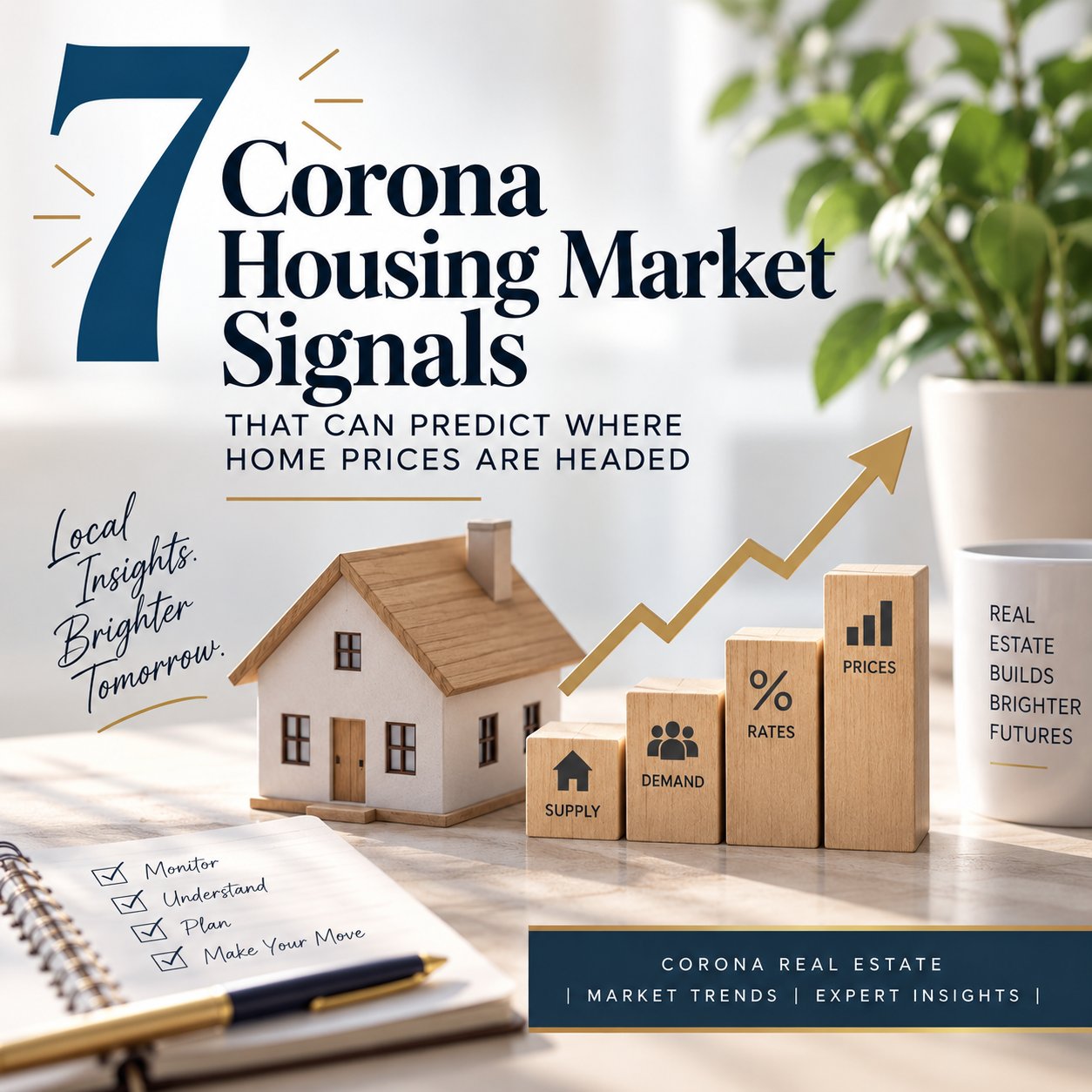
7 Corona Housing Market Signals That Can Predict Where Home Prices Are Headed
September 21, 2026
Buying & Selling
September 21, 2026
Buying & Selling
Home prices do not move because someone on the internet declared that “the market is crashing” or “everything is bidding up.” In Corona, the better clues are local: inventory, days on market, price reductions, pending activity, new listings, sale-to-list price, and mortgage demand. Watch the dashboard—not the drama.
If you want to know where Corona home prices may be heading, do not start with a national headline. National headlines are useful for getting your blood pressure up before breakfast. They are much less useful when you are deciding what to offer on a home in Eagle Glen, whether to list in South Corona, or whether your pricing strategy in Sierra Del Oro actually makes sense.
Real estate is local—sometimes painfully local.
A buyer looking at a condo near Dos Lagos is not shopping in the same market as someone considering a pool home in The Retreat. A seller in Horsethief Canyon should not automatically use the same pricing logic as a seller near Corona Ranch or downtown Corona. Even within the city, buyer demand, price points, school preferences, HOA costs, commute patterns, and available competition can change the conversation quickly.
The good news: you do not need a crystal ball. You need to watch the right signals.
1. Active inventory
Inventory is simply the number of homes currently available for buyers to purchase.
When inventory rises, buyers get more choices. More choices usually mean sellers need to work harder on price, condition, presentation, and terms. When inventory falls, well-prepared homes tend to have more leverage.
That does not mean every seller must panic when new listings appear. More homes for sale can be perfectly normal during certain times of year. What matters is whether available homes are rising faster than buyer demand—and whether comparable homes are actually selling.
For Corona sellers, the question is not, “How many homes are on the market?” The smarter question is:
> “How many homes like mine are competing for the same buyer this week?”
That is the number that affects your strategy.
2. Days on market
Days on market tells us how long homes are taking to secure a buyer. It is one of the easiest metrics to understand and one of the easiest to misuse.
A property sitting longer does not automatically mean it is a bad house. It may mean the home was overpriced from day one, launched with weak photography, missed the condition standard for its price range, or entered the market with a seller who believed the backyard view alone would pay for every upgrade they did not make.
Corona homes were going pending in around 28 days as of late July 2026, according to Zillow’s market data. That is a helpful benchmark, but the real comparison should always be against similarly priced and similarly located homes.
A clean, correctly priced home in a popular Corona neighborhood may move much faster. A higher-priced property, a home with a challenging lot, or one requiring updates may need more runway.
3. Pending-to-listing activity
Pending sales are often more useful than closed sales when you want to see where the market is going now.
Closed sales tell you what buyers agreed to weeks ago. Pending sales tell you what buyers are saying yes to today.
If new pending's rise while inventory remains stable, that can suggest improving buyer demand. If listings pile up but pending activity slows, sellers may need to become more realistic—before their home becomes one of those listings buyers scroll past because it has been “new” for 73 days.
The market does not send a handwritten note when momentum changes. Pending activity is often one of the earlier clues.
4. Price reductions
Price reductions deserve more attention than they get.
A reduction does not mean a seller has failed. Sometimes it is a smart and strategic correction. But when reductions become widespread across a neighborhood or price range, that often tells us buyers are resisting the original asking prices.
In Corona, buyers are still value-conscious. Zillow’s data showed 45.7% of sales were under list price as of June 2026. That does not mean buyers can offer whatever they want and expect champagne at closing. It does mean sellers should understand that an ambitious price is not a strategy by itself.[1]
The first 10 to 14 days on market are valuable. If your home launches too high and misses its strongest buyer audience, the listing can lose momentum. A price adjustment later may help—but it rarely recreates the attention you had the first time your home appeared as “just listed.”
5. Sale price versus list price
This is the metric that reveals whether sellers are getting what they ask for—or simply asking for it enthusiastically.
The sale-to-list-price ratio compares what a home sells for with its final asking price. When homes consistently sell at or above list price, seller leverage is generally stronger. When the ratio weakens, buyers have more room to negotiate.
But remember: this metric can be misleading if sellers have already reduced their homes two or three times before accepting an offer. A home may sell at 100% of its final list price while still selling below the original number.
That is why I look beyond the headline percentage. We need to know:
- What was the original list price?
- How many price changes occurred?
- How long did the property sit?
- What concessions were negotiated?
- How does the property compare with the active competition?
That is where the real story is.
6. New listings versus buyer demand
New listings are not inherently bad for sellers. Fresh inventory gives buyers something to tour, agents something to market, and the local market a little oxygen.
The concern arises when new supply repeatedly outpaces buyer absorption. If 30 comparable listings arrive and only 10 go pending, the market is telling us something. Not rudely. Just clearly.
Sellers should watch whether buyers are absorbing new listings in their price segment. For example, demand for entry-level homes, family homes near commuter routes, or turnkey properties can look very different from demand for luxury homes with premium upgrades and higher monthly carrying costs.
7. Mortgage applications and interest rates
Mortgage rates affect affordability, and affordability affects what buyers can pay. There is no way around it.
When rates improve, more buyers may qualify, purchasing power can expand, and activity can increase. When rates rise, buyers may not disappear—but their budgets may shrink, their payment sensitivity rises, and they become more selective.
That is why I never look at home prices without looking at financing conditions. The buyer who loved your home at $900,000 may still love it when rates rise. They may simply not be able to buy it at that number anymore.
What Corona sellers should do now
The local market rewards preparation and punishes assumptions.
If you are planning to sell in Corona, focus on the controllables:
- Price based on current competition and recent buyer behavior—not on your neighbor’s dinner-party estimate.
- Prepare the home to meet the standard buyers expect at your price point.
- Use professional marketing that earns attention in the first week.
- Review weekly activity: showings, online engagement, feedback, competing listings, pendings, and reductions.
- Adjust strategically when the market gives you evidence—not emotionally after three months of silence.
What Corona buyers should do now
Buyers have opportunities when they understand the local data.
If a home is new, well-priced, turnkey, and in a high-demand area of Corona, act like it has competition—because it probably does. If a listing has been sitting, has had reductions, or faces strong competing inventory, that may create room for a more thoughtful offer, credits, repairs, or terms.
The goal is not to “win” a negotiation. The goal is to buy the right home at terms that still make sense when the excitement wears off and the first mortgage payment arrives.
FAQ
Are Corona home prices going up or down?
The answer depends on the specific neighborhood, price point, property condition, and buyer demand. Instead of relying on one citywide number, review recent comparable sales, active competition, pending sales, and days on market for homes similar to yours.
What is the best housing-market indicator for Corona sellers?
There is no single magic metric. The most useful combination is active inventory, days on market, pending activity, price reductions, and sale-to-list-price trends for your immediate competitive set.
How long are Corona homes taking to sell?
Zillow reported a median of roughly 28 days to pending in Corona in late July 2026, although individual properties can move much faster or more slowly based on pricing, condition, location, and market segment.
Thinking about buying or selling in Corona? Before you make a pricing decision based on a headline, get a neighborhood-specific strategy based on the homes buyers are actually choosing right now.
Don’t forget to subscribe for more Corona real estate insights, local market updates, and homeowner tips!
Thinking about buying or selling in Corona? Let’s connect.
Email: [email protected]
Phone: 714-287-0669
Website: ExploreCorona.com | Dianareneehomes.com
Diana Renee Homes | DRE #01150595

Diana Renee
I am so fortunate to have grown up in one of the most wonderful places in the world, California. With friendly people, incredible weather, great entertainment, beaches, mountains and the desert all within driving distance, SoCal has it all. I was born and raised in Long Beach, and have lived in Corona since 1996. I truly love this city and I'm proud to assist my clients in navigating the process of buying and selling real estate.
Stay up to date on the latest real estate trends.
Buying & Selling
September 21, 2026
September 21, 2026

September 18, 2026

housing market
September 16, 2026
September 14, 2026
housing market
September 9, 2026

Buying & Selling
September 9, 2026
All about Corona, California
September 7, 2026
California
September 4, 2026
I WANT TO HEAR FROM YOU