How Much Does a Mortgage Rate Change Actually Cost You Per Month?
August 19, 2026
Mortgage
August 19, 2026
Mortgage
I get this question at nearly every open house I hold in Corona: "Is it worth waiting for rates to drop?"
People imagine mortgage rates as this abstract economic indicator on the news ticker. They're not.
They're a very real number that shows up on your bank statement every single month for the next 30
years. Let's make it concrete.
The Actual Payment Math
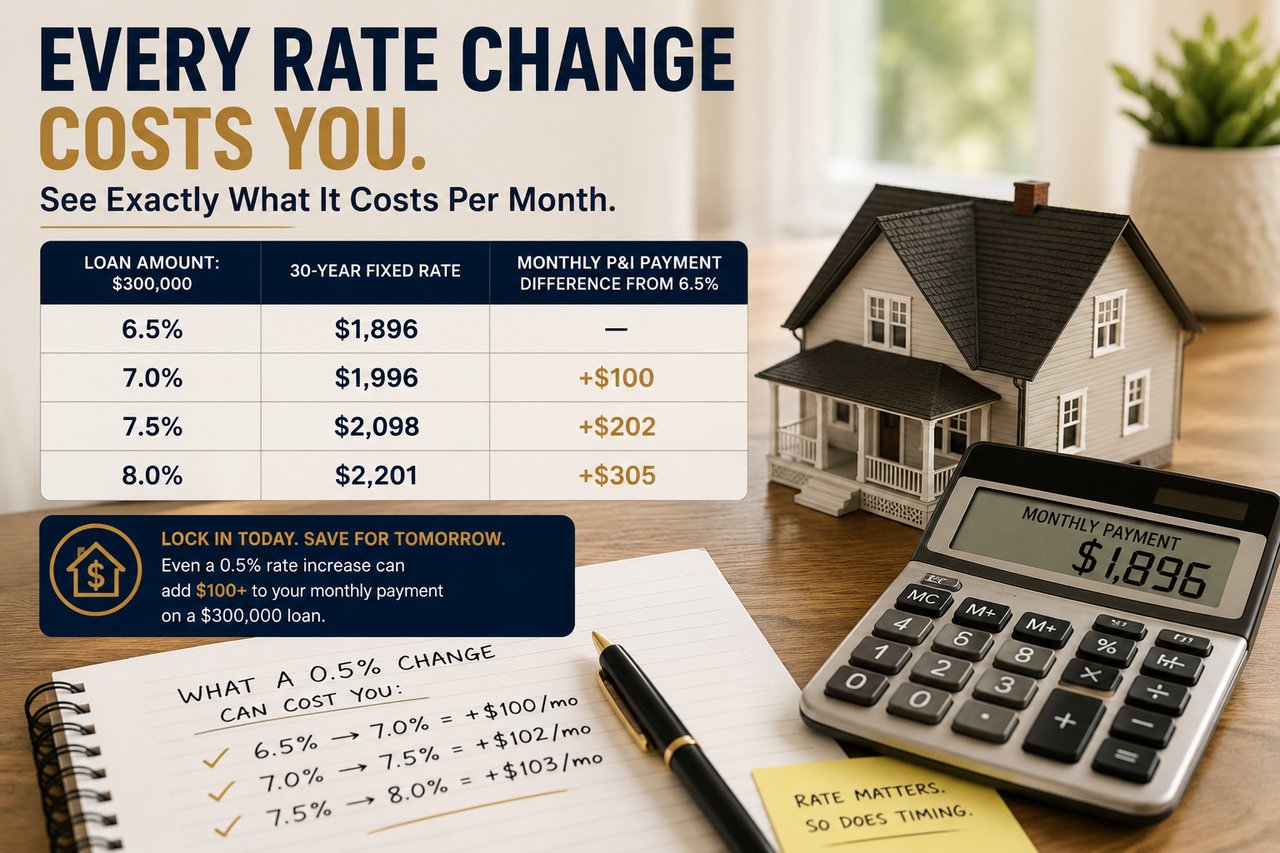
Here's what a $300,000 loan (principal and interest only, no taxes or insurance) looks like at different
rates, straight from Freddie Mac's own numbers (Freddie Mac MyHome):
Rate Monthly P&I Difference from 6.5%
6.5% $1,896 —
7.0% $1,996 +$100
7.5% $2,098 +$202
8.0% $2,201 +$305
Notice that the jump isn't linear — you lose a little more with each half-point because you're financing a
bigger interest bill on the same principal. That's not a Corona quirk, that's just how amortization works
everywhere.
Scaling It to a Real Corona Loan
Now, $300,000 is a nice round number for a spreadsheet, but it's not what most people are actually
borrowing here. Corona's median sale price is $799,522 as of the most recent Redfin data through May
2026 (Redfin), and South Corona specifically runs even higher, with Zillow pegging the typical home
value at $928,944, up 4.1% year-over-year (Zillow, per prior research).
Assume a buyer puts 10% down on a $799,522 Corona home — that's a loan of roughly $719,570, more
than double my $300,000 example above. Scale the table proportionally and the swings get serious fast:
the difference between 6.5% and 8% isn't $305 a month anymore, it's closer to $730 a month. That's a
car payment. That's a kid's daycare bill. That's real money, every month, for as long as you hold that
rate.
Why This Matters More Than Chasing the "Bottom"
Here's my actual advice, and it's not what rate-doom headlines want you to hear: obsessing over
whether rates will dip another quarter-point is usually a worse strategy than locking in a rate you can
comfortably afford today. As of late July 2026, Freddie Mac's weekly survey had 30-year fixed rates at
6.43% (week of July 2, 2026), while daily trackers like Mortgage News Daily showed 6.43%–6.60% and
Mortgage Research Network showed 6.73% on July 30, 2026 (Freddie Mac, Mortgage News Daily,
Mortgage Research Network). That's a meaningfully better environment than the 7.5–8% range we saw
in prior years, but rates can and do move week to week.
The Fed didn't make this easier to predict. On July 29, 2026, the Federal Reserve held its benchmark rate
steady at 3.50%–3.75% for the fifth straight meeting, and three dissenters actually wanted to raise rates
further due to inflation concerns (Federal Reserve, CNBC). Translation: nobody on the actual committee
that sets this stuff is promising you a rate cut is imminent. If you find a home you love and a payment
you can sustain, waiting on a maybe isn't a strategy — it's a gamble with your monthly budget as the
chip on the table.
The Refinance Safety Net
One more thing I tell every buyer: your rate today isn't necessarily your rate forever. If rates do fall
meaningfully in 2027 or beyond, refinancing is always an option — but you can't refinance a house you
never bought because you were waiting for a rate that never came.
FAQ
Q: How much more expensive is a 7% mortgage versus a 6.5% mortgage on $300,000?
A: About $100 more per month ($1,996 vs. $1,896 in principal and interest .
Q: Does a 0.5% rate change matter on a larger, Corona-sized loan?
A: Yes — proportionally more. On a loan near $720,000 (typical for a 10%-down purchase at Corona's
$799,522 median price), a 0.5% move can shift your payment by $200+ per month
Q: What are mortgage rates doing right now, in July 2026?
A: 30-year fixed rates are in the mid-6% range — Freddie Mac's weekly survey showed 6.43% for the
week of July 2, 2026, while daily trackers showed a range from about 6.43% to 6.73% in late July.
Q: Should I wait for rates to drop before buying in Corona?
A: Not necessarily. The Fed just held rates steady for the fifth straight meeting with no clear signal of
imminent cuts, and three officials actually wanted to raise rates (Federal Reserve). A home you can
afford today, with the option to refinance later, often beats an indefinite wait.
Q: Can I lower my payment without waiting for rates to fall?
A: Yes — buying down your rate with points, adjusting your down payment, or exploring low-down-
payment programs can all change your monthly number. Ask Diana about first-time buyer programs
available in the Corona/Riverside area.
Ready to see what your actual payment would look like on a specific Corona home? Call Diana Renee
at (714) 287-0669 for a personalized payment breakdown — no spreadsheet guesswork required. DRE
01150595 | dianareneehomes.com, Explorecorona.com

Diana Renee
I am so fortunate to have grown up in one of the most wonderful places in the world, California. With friendly people, incredible weather, great entertainment, beaches, mountains and the desert all within driving distance, SoCal has it all. I was born and raised in Long Beach, and have lived in Corona since 1996. I truly love this city and I'm proud to assist my clients in navigating the process of buying and selling real estate.
Stay up to date on the latest real estate trends.
October 1, 2026

housing market
September 30, 2026
September 29, 2026
Exploring the remarkable Sycamore Creek neighborhood, one of Corona's most sought-after planned communities.
September 28, 2026

Lifestyle
September 25, 2026
September 25, 2026
September 21, 2026
September 18, 2026

housing market
September 16, 2026
I WANT TO HEAR FROM YOU